


Innovation Unleashed
Velchamy Sankarlingam ’95 shares how his education and experience continue to shape his career
By Melinda Church
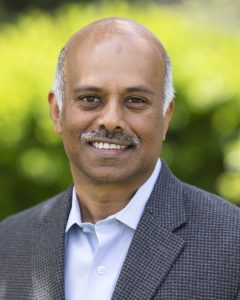
Velchamy Sankarlingam credits the broad education he received at Stony Brook with helping him to succeed with the move into technology management.
Some advice for anyone who has a conversation scheduled with Velchamy Sankarlingam, MS ’95: Come caffeinated and well-rested. Keeping up with him, his extraordinary career and his fast-working mind requires a lot. He’s a broad thinker who talks about connecting and changing the world.
Velchamy is president of product and engineering for Zoom Video Communications Inc., a role he took on in July 2020. Let’s return for a moment to those dark, socially isolated days to understand the context in which he operates — and the scale of the challenges he seeks out.
In spring 2020, several years into a successful career at VMware, where he was senior vice president of cloud services development and operations, Velchamy got a call from one of his best friends from their days as Webex colleagues. Zoom CEO Eric S. Yuan was asking if he would join him at the company which, in a matter of weeks in early 2020, underwent an astounding amount of growth in meeting participants.
It was a challenge too good to refuse and was an opportunity to work with Yuan again. Velchamy’s experience and education made him precisely the right person for the job. He combines deep technical chops with management expertise — strategic thinking honed through his time earning a master’s degree in business and policy from Stony Brook University.
An Agent of Opportunity
At Stony Brook, Velchamy found the right place, at the right time, with the right educational approach. He and his wife, Vidya, moved to Long Island in 1993, shortly after they were married. They found an apartment close to Stony Brook and began settling in. As a software engineer working at Standard Microsystems on Long Island, he was plenty busy, but he was driven to do more.
By fall, he’d started his master’s program. “I came from a strong technical background,” Velchamy said. “I had an electrical engineering bachelor’s degree and a master’s in computer science, but I always wanted to earn a management degree.”
Stony Brook’s master’s program was designed for working professionals, and its flexibility and proximity to work and home made the effort doable. At the time, the program was part of the Harriman School for Management and Policy. Today, the College of Business, which was founded in 2004, continues that tradition and offers a range of degrees for working professionals.
Velchamy took advantage of Stony Brook’s breadth, enrolling in courses in math and writing along with business. “I learned so much from all of my classes because I was a purely technical person before that.” That broad education, he said, enabled him to move into technology management.
Waiting for the World to Catch Up
While thousands of new alumni celebrated their degrees at Stony Brook’s commencement ceremony in 1995, Velchamy was 3,000 miles away. Several months earlier, just after finishing his classes and submitting his master’s thesis, he and Vidya were on the move — this time to the Bay Area, where he had accepted a new job.
Life was full and good, but there was a snag: His professor sent back Velchamy’s thesis — with numerous questions.
The paper’s topic was a simulation project on how to forecast internet traffic, and Velchamy used several acronyms — such as WWW — that are ubiquitous now, but were not common vernacular at the time.
It’s tough to remember a time before the internet was integral to life, work and play. But in early 1995, when Velchamy submitted his thesis, the internet was in its infancy. Commercial internet service providers first entered the market with subscription services in 1995. And it’s the year when television host David Letterman, interviewing Bill Gates, asked, “What the hell is [the internet] exactly?”
Velchamy’s business professor could hardly be blamed for his puzzlement over the acronyms.
Several months went by in California, and “at some point, I realized I’d not yet done any corrections on the paper,” said Velchamy.
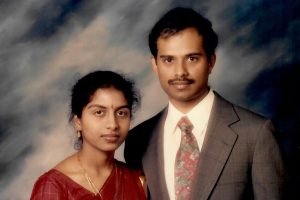
Velchamy and Vidya Sankarlingam at a company Christmas party during their time on Long Island in the early 1990s.
Knowledge of internet acronyms was spreading fast, though, and by the time he addressed his professor’s comments and questions, the world had caught up. Velchamy made a few edits, spelled out some terms and resubmitted the paper, which was quickly approved.
A Family Ethos
With a bachelor’s and two master’s degrees, Velchamy’s quest to learn is unquenchable. In the fast-moving industry in which he leads, continuous innovation requires continuous education. He has completed the Stanford Executive Program at Stanford University’s Graduate School of Business. “He loves to learn,” confirmed Vidya.
It’s clear that sitting still is not in her nature, either. What Vidya describes as her “volunteer work” amounts to senior leadership of a multinational education enterprise. Not long after moving to California, she started helping a friend, who founded a school to teach Tamil. Both she and Velchamy were born in the state of Tamil Nadu in southeast India.
“I wanted my kids to study my language,” she explained. “At first, we were in a garage teaching our language to seven students.”
Today, some 26 years later, their school — the International Tamil Academy — reaches 3,000 students in the Bay Area, from preschool through high school. Its curriculum is accredited by local school districts, enabling students to earn high school course credits. The academy reaches an additional 15,000+ students through affiliated schools across the United States and around the world. As the academy’s volunteer administrative leader, Vidya oversees all finances, insurance, personnel and facilities.
She credits Velchamy with supporting her work to launch and grow the school while raising their three daughters. “Without his support, I don’t think I could have done this,” she said. “Whenever I need him, he’s there. He said, ‘Go for it.’”
The couple are financial supporters of Stony Brook’s College of Business, and continue to engage with the university. They view their philanthropy as giving back to an institution that helped propel their lives and careers. “The university has helped me, and I should help it in return,” said Velchamy.
College of Business Dean Haresh Gurnani notes that the support provided by Velchamy, Vidya and others is essential to the college’s excellence. “Unrestricted resources have an outsized impact,” said Gurnani. “They enable us to be bold, to innovate, and to capitalize on opportunities that strengthen the college and the education we provide.”
Lasting Impact
After more than 20 years on the West Coast, Velchamy and Vidya visited Stony Brook a few years ago. Their oldest daughter, who was born at Good Samaritan Hospital during their last few months at Stony Brook, was entering Columbia University to study law. “We drove to Stony Brook,” said Vidya. “We showed her where she was born, the hospital, the place where we lived, and the university.”
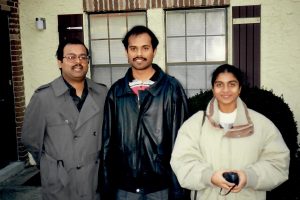
The Sankarlingams in front of their Long Island apartment, along with Vidya’s cousin’s husband, from the mid-1990s.
For Vidya, Stony Brook was especially formative; it was her first home in the United States. Coming from the tropics of southern India, the memory of shockingly cold winters sticks with her still. She took a few classes at Stony Brook and spent time with a cousin in Connecticut. “It was a very nice, small community,” she said about Stony Brook. “In the summer, Velchamy and I would pick cherries and tomatoes. We really liked living there.”
Despite their decades away, their interest in the university remains strong. “I follow the university closely,” said Velchamy. “Stony Brook has made a lot of progress and is much more prominent nationally since I graduated.” Among the areas of excellence he cites are quantum physics and significant investments in research. “I believe Stony Brook has found the right balance as a public university that is very affordable while also conducting so much high-end research.”
Eyes Ever Trained on the Future
Velchamy’s view of the future of work highlights his global perspective, deep technical expertise and a management style that is all about enabling others. His team oversees Zoom’s products, development and technology — a large portfolio that is just right for a man who embraces problem-solving and creating something new.
As artificial intelligence (AI) becomes an increasingly important part of how the world works, Velchamy is committed to seeing that no one is left behind, that an AI divide doesn’t happen on his watch at Zoom. “AI will touch every part of society,” he explained. “It’s going to be much bigger than the internet revolution, and it’s going to be much faster as well.”
He wholeheartedly endorses Zoom’s corporate stance on ensuring AI is available to all of its subscribers, with functions that are included in the basic fees. He and his team have introduced AI-enabled features such as meeting transcriptions and summaries and the ability to see tasks assigned to individuals.
Velchamy’s approach to leadership centers on empowering others and focusing on business goals. He explained: “The combination of the technical background and the management background allows me to know what to do, when. When does the team need me, and when do they need me to step out of their way and empower them? The goal is making sure I’m not needed.”
He favors one-year career plans for reasons that are both practical and values-driven. “Our industry is evolving so quickly, and it keeps me focused. But more, it’s about long-term career plans becoming political — like building and protecting a fiefdom, which I’m not interested in.”
When asked about advice he might offer to new Stony Brook alumni, Velchamy’s response reflects the realities of increasing globalization and porous edges between work and life. “It’s going to be very, very difficult to find a work-life balance,” he said. “So whatever direction you choose needs to be a personal passion that you have a talent for. If you’re good at it, go for it.”
Melinda Church specializes in philanthropy, science, and health writing. She is based in Columbus, Ohio.